How to Read an Insulin Syringe in Units Without Scale Mixups
Barrel, plunger tip, scale steps on 0.3, 0.5 and 1 mL barrels, dead space and the documented U-100 versus U-40 mixup, explained as a ruler lesson.
Stop 11 of 15 on the Bench Line.
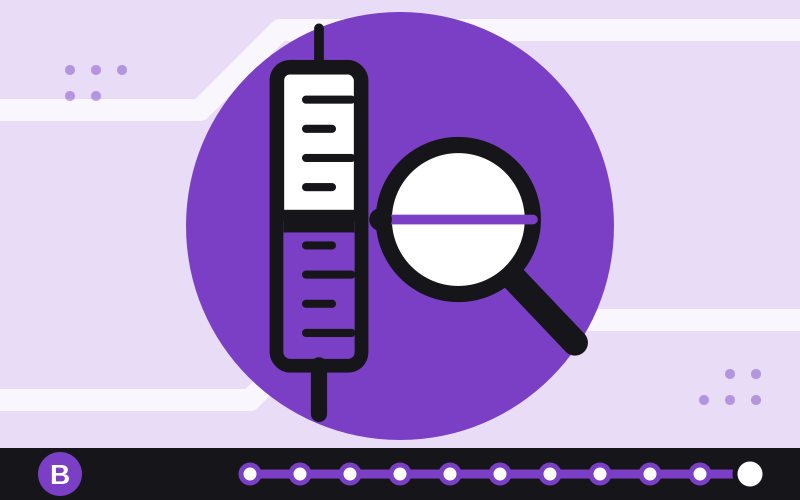
Learning how to read an insulin syringe in units comes down to three checks: which scale the barrel carries, how large its smallest step is, and where on the plunger you look. The reading point is the plunger tip, the front edge of the rubber seal that faces the needle. This Bench stop names the parts of the barrel, compares the scale steps on small and large barrels, explains dead space, and looks at the U-100 versus U-40 mixup that case reports keep recording. It teaches how to read a printed scale and gives no dose of any kind.
The Parts of an Insulin Syringe Barrel
An insulin syringe has a handful of parts worth naming before any reading starts. The barrel is the clear tube with the printed unit scale. The plunger is the rod you push and pull, and at its front end sits a rubber stopper that slides inside the barrel and seals it. The needle on most insulin syringes is fixed to the barrel with no detachable hub, and it sits under a cap or shield. A flange at the back gives the fingers something to hold. The scale runs from zero at the needle end to full capacity near the flange. Long lines carry printed numbers, short lines between them mark the smallest steps, and each line stands for a volume.
The box tells you what the scale was built for. A pack printed U-100 means the numbers assume a liquid holding 100 units in each milliliter, so the top mark of a 1 mL barrel reads 100. A U-40 pack assumes 40 units per milliliter, and its full barrel reads 40. Boxes also state the barrel volume, the needle length and the gauge. Device records in the Global Unique Device Identification Database, published by the National Library of Medicine, list the same details for each registered model, including the scale step. Before reading any line, check that the box, the barrel and the vial label all name the same U code, because the scale is only correct for its own strength.
Scale Steps on Small and Large Barrels
The smallest step changes with barrel size, and this is the most common reason two people read the same fill differently. Small 0.3 mL barrels usually step in single units, and some models are printed in half units; one device record describes a 0.3 mL syringe with a half unit scale. Barrels of 0.5 mL are usually marked in single units. Many 1 mL barrels step in 2 units, and another record lists a 1 mL model marked in 2 units. On a 2 unit scale, an odd number falls between two short lines, and the eye has to split that gap. Smaller barrels place their lines farther apart, so less splitting is needed and the count is easier.
| Syringe size | Total U-100 units | Smallest mark on common models | Volume of one smallest step |
|---|---|---|---|
| 0.3 mL | 30 units | 1 unit, half unit on some models | 0.01 mL or 0.005 mL |
| 0.5 mL | 50 units | Usually 1 unit | 0.01 mL |
| 1 mL | 100 units | Often 2 units | 0.02 mL |
Count before you trust a number. Find the nearest numbered line below the plunger tip, then count the short lines up to it and multiply by the step printed for that model. On a 1 mL barrel with 2 unit steps, three short lines past the 20 mark means 26 on the U-100 scale, which is 0.26 mL of liquid. On a 0.3 mL barrel with 1 unit steps, three short lines past 10 means 13, or 0.13 mL. The habit catches slips early: if the count and the nearest printed number disagree, the step was misread. None of these figures refers to a dose of anything. They are counting drills on a printed ruler, and they work the same way whatever liquid sits in the barrel.
Reading at the Plunger Edge and Dead Space
Where you look matters as much as what you count. The approved instructions for Humulin R U-500 vials describe pushing until the plunger tip reaches the dose line, which makes the tip, the front edge of the stopper facing the needle, the reading point. The back of the stopper and the end of the rod sit farther along the barrel and would give a larger number. Hold the barrel at eye level so the line and the tip are seen straight on, not from an angle. The same instructions mention tapping to let air bubbles rise, and the reason is plain physics: a bubble takes up space on the scale, so the line counts air as if it were liquid.
Dead space is the small volume left inside the hub and the needle after the plunger is fully pushed in. It is not shown on the scale, and it is one reason insulin syringes usually have needles fixed to the barrel. In a 2018 comparison of two syringe types for a clinic injection, a 1 mL tuberculin syringe with a detachable needle still held 0.05 mL in its hub after use, while a 1 mL insulin syringe with an attached needle left far less behind. Virus survival studies, and a World Health Organization recommendation for needle programs, rest on the same design difference. When you learn how to read an insulin syringe in units, remember that the scale counts what is in the barrel, not what remains in the needle.
U 100 vs U 40 Syringes and Documented Mixups
The comparison of U 100 vs U 40 syringes is the clearest warning about scales. A U-100 barrel marks each unit at 0.01 mL, while a U-40 barrel marks each unit at 0.025 mL, so the same printed number means two different volumes. A U-40 syringe filled to a given mark with U-100 insulin holds two and a half times the intended amount. A 2019 case report in Case Reports in Endocrinology described a 30 year old man who used veterinary U-40 syringes to draw his prescribed U-100 insulin and had repeated episodes of low blood sugar. The authors note that U-40 insulin does not exist for humans in the United States but is common for animals.
Mixups also run in the opposite direction. The FDA approved owner leaflet for Vetsulin, a U-40 pet insulin, says to use it with U-40 syringes only, because any other syringe will result in incorrect dosing. A U-100 syringe would hold less than half the intended amount at the same mark. Concentrated human insulin adds a third scale: the Humulin R U-500 leaflet warns that a U-100 syringe used for a U-500 dose can give a five times overdose, which is why that product has its own syringe. The lesson in every case is the same. Knowing how to read an insulin syringe in units is useful only after the U code on the box matches the U code on the vial.
Conclusion
How to read an insulin syringe in units, in short: check that the U code on the box matches the vial, find the smallest step for that barrel size, count lines up to the plunger tip at eye level, and remember that dead space sits outside the scale. U-100 and U-40 barrels print the same numbers at different volumes, and case reports show what follows a mixup. Leave every dose question to a prescriber or a pharmacist.
Sources
End of this stop
Done reading? Mark it, and the map, the line strips and the planner will tick it off.
Education only, not medical advice. No personal dosing advice and no sellers. See the disclaimer.